
Shifting Sands
Roy Hibbert and the changing profile of key position forward draft prospects

Around 2013 Indiana Pacers centre Roy Hibbert was anchoring one of the NBA’s best defences. He was making All-Star teams and in contention for Defensive Player of the Year awards. Barely a few seasons later he was consigned to the role of a bench warmer and was soon out of the league. Hibbert’s fall from grace was unique in that it was not due to any decline in ability or injury but that the league had redefined itself.
The 3 point shot was taking over. Teams were going smaller. Centres and forwards were spacing out. The offense now revolved around outside shots and the “pick’n’roll”. This shift in game play diminished Hibbert’s greatest strength and highlighted his inability to switch in the pick’n’roll action. Offensively he was not flexible enough to adapt to the new requirements of the centre position. Just like that, Hibbert went from being a star centre to borderline unplayable.
With the AFL Draft approaching, attention has turned to who the Crows may select with the first pick. The top end of the draft is dominated by key position forward talent. In recent years there has been a trend against taking forwards at the top of the draft. I looked back at the top 10 selections of each draft from 1997 to 2019. For 19 straight years at least one key position forward was taken top 10. Three times in the last four years, none were taken top 10.
I ran a Twitter Poll asking people to vote on why they thought less key forwards had been drafted at the top of the draft in the last few years:
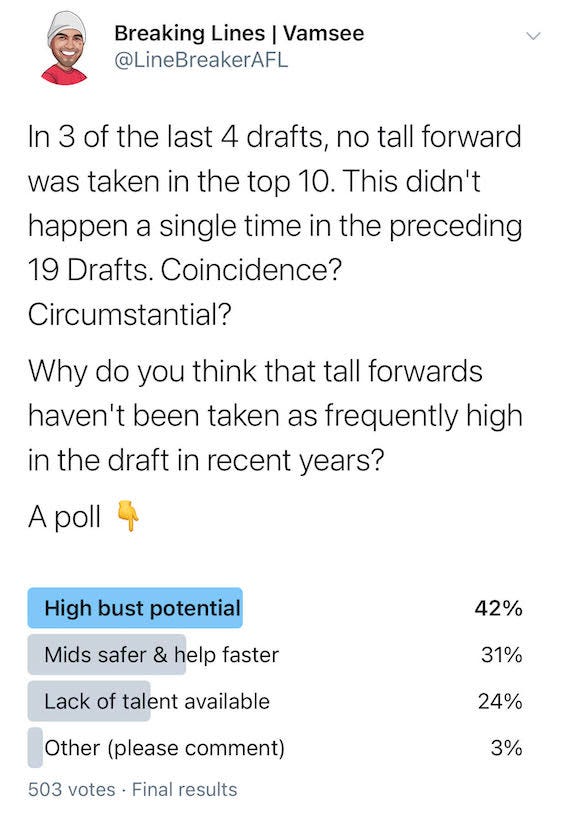
The majority view is that list managers are wary of the high risk associated with key forwards and that taking a midfielder represents a safer option. Looking back through the last 23 drafts the top end is littered with tall forwards that did not pan out.
On the other hand, most of the dominant key forwards of the last 20 years were taken at the top end of the draft. To obtain a gun forward chances are a top pick will be required, even if they carry significant risk.
Why is it that for 19 years in a row a key forward was taken top 10 and then in 2016, 2017 and 2019, none were taken?
Some have suggested that the disappointing careers of Patton, Boyd, Schache and McCartin led to risk aversion from list managers. I do not believe this is the reason. Recruiters are aware that tall forwards take more time to develop. Schache was drafted in 2015 so I’d be surprised if the reflex to avoid forwards occurred that quickly. Furthermore, Tom Boyd’s dominant 2016 Finals series would’ve highlighted the benefit of having an elite tall forward.
I posit that the reason why we have seen fewer key forwards drafted at the top end is because the type of forward recruiters are now looking for is simply harder to find.
The role of a tall forward has changed significantly over the past 5 years or so. It is no longer sufficient to be a 200cm behemoth that is able to take a contested mark. Tall forwards are now required to get to more contests, take contested marks, compete at ground level and importantly apply significant defensive pressure. We now need our forwards to be extraordinary athletes. Perhaps the reason why tall forwards have not appeared at the top in three of the last 4 drafts is not because recruiters are afraid of drafting them but because this contemporary archetype is far rarer than the old-fashioned power forward type?
Boyd, Schache, McCartin and Patton may have entered the league in the wrong era. Health issues aside, it is not a stretch to envisage each of them dominating the comp a decade earlier.
2018 bucked the recent trend of tall forwards being absent at the top of the draft. Jack Lukosius, Max King and Ben King all were taken early. The difference in stature between these forwards and the four that were taken in the years before them are plainly obvious:
Josh Schache: 199cm, 98kg
Patrick McCartin: 194cm, 94kg
Tom Boyd: 201cm, 102kg
Jonathon Patton: 197cm, 100kg
————————————————————
Jack Lukosius: 195cm, 85kg
Max King: 204cm, 90kg
Ben King: 202 cm, 87kg
The prior quartet were built differently. Thick and strong through the core. Strong chest and shoulders. The 2018 crop are not built like that. They are leaner and far more athletic in their movement. They are the true modern day forward that is able to crash a pack, take a contested mark, roam up the ground, compete when the ball hits the deck and pressure the opposition when the ball is turned over. The days of the key forward being able to sit in the goal square and lead into open spaces and then catch their breath when the opposition take possession is no longer. But this is the type of game that Schache, McCartin, Boyd and Patton were built for. Just like Roy Hibbert suffered with a changing game, these tall forwards were blessed with a skillset that was no longer as effective.
One must be careful about reasoning by analogy. It is better to reason by first principles. Why did Boyd et al fail to live up to expectations and how do those reasons pertain to this current crop we are trying to project? It is difficult to assess a player who is of enormous stature and playing against school kids most of whom will not sniff state level standard let alone the AFL. How much of a prospect’s dominance is simply due to their advanced physical stature? A response to my Twitter poll made an excellent point about the anti-congestion TAC Cup rules and how this may be artificially opening up the game which is not representative of how the game is played at AFL level.
It is anomalous that the Patton, Boyd, Schache, McCartin quartet all failed to live up to expectations. All except Schache (pick 2) were taken at pick 1. The fact that they all entered the league in short succession and each struggled to have consistent impact to me suggests external factors. Injuries certainly played a part. The changing expectations of what teams needed their tall forwards to do however also likely played a significant role. Recruiters remain on the lookout for elite forwards, but it is no longer the power forward that they are seeking.